Pluribus, the Hive Mind and the Power of Science Fiction to Warn Us
Even two moviemakers preparing a slate need to lower the drawbridge once in a while. Elizabeth and I are preparing the latest slate from Overactive Imagination Pictures for the American Film Market. So we rested up and watched a documentary we had somehow never had the fortitude to watch before: *Mussolini: The First Fascist*. Yeah, that’s how we roll. What followed led me directly from Mussolini’s fascism to the Pluribus hive mind—and to one of the most important warnings science fiction can give us before reality catches up.
Mussolini appealed to an Italy traumatized by World War I,
economic hardship, political violence and widespread frustration with parliamentary government. He wrapped himself in the grandeur of ancient Rome, promised national rebirth and presented himself as the strongman who alone could make a faltering country work again. After becoming prime minister in 1922, he did not abolish Italian democracy in one dramatic afternoon. His government progressively weakened opposition, independent institutions, elections and the free press until dictatorship was consolidated.
The documentary was released in 2020, but it’s as current as today’s headlines as our democracy is slowly being terraformed into a totalitarian state powered by AI. I found the parallels to America deeply unsettling—not because history repeats itself scene for scene, but because democratic erosion often happens incrementally. Each loss can be explained as temporary, legal, necessary or too small to panic about. By the time the pattern becomes undeniable, everyone is standing around wondering who misplaced the republic.
That concern is not based on a documentary alone. The nonpartisan V-Dem Institute’s 2026 Democracy Report describes an unusually rapid decline in American checks and balances and civil liberties during 2025, reclassifying the United States from a liberal democracy to an electoral democracy. Whether one uses the word *fascism*, *authoritarianism* or *democratic backsliding*, the removal of freedom by degrees deserves our full attention.
I give *Mussolini: The First Fascist* five stars and strongly recommend it. It is currently available through Prime Video. What struck me most was how closely its history echoed not only the last ten years of the rise of techno fascism, but also echoed through the terrifying hive-mind totalitarianism imagined in Apple TV+’s *Pluribus* that premiered in November 2025.
Long before a dangerous future becomes real, science fiction allows us to walk through it, experience it and—if we are paying attention—choose another path.
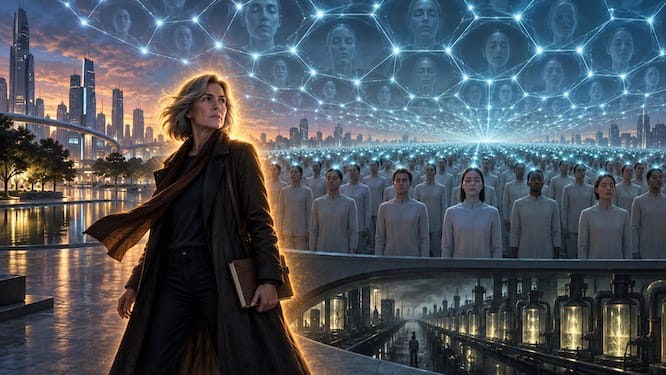
Picture a world where war disappears. Poverty disappears. Conflict disappears. Billions of people are peaceful, helpful and happy in Pluribus, except for the handful of individuals resistant to the virus, because nearly all humanity has been joined into a single collective consciousness.
It sounds like paradise.
Now imagine discovering that this paradise required the extinction of the human self.
That is the world of *Pluribus*, created by Vince Gilligan and starring Rhea Seehorn as Carol Sturka. Its horror is not that people have become violent monsters. It is that they have become perfectly agreeable. Individual consciousness, free will and the beautiful friction between distinct human beings have been absorbed into one benevolent mind.
The prison has no bars because everyone inside feels wonderful within a unified field of shared consciousness.
Nature contains societies that superficially resemble this kind of absolute conformity. Ants, honeybees, wasps and termites live in highly organized colonies with rigid roles. Reproduction may belong almost entirely to one queen. Workers serve the colony, police one another and sometimes destroy eggs laid by other workers. Naked mole rats offer a rare mammalian example, with one dominant queen monopolizing reproduction while most of the colony remains non-breeding.
But these animals have not surrendered individual freedom to a ruler or hive. Their behavior evolved biologically over millions of years. A worker bee is not an independent citizen whose consciousness has been politically erased. The colony functions more like a single larger creature—a super-organism.
Human beings are not ants. Though some governments appear determined to test the proposition.
History has proven time and again that humanity’s natural state is free-flowing and independent. We are social creatures, but we are also improvisational, eccentric, contradictory and nearly impossible to standardize. We need one another, yet we continually question, reinterpret and reinvent the group.
That may explain why totalitarian systems become so brutal. They attempt to force a naturally diverse species into an unnatural condition of uniformity. Because people do not willingly surrender their inner lives, persuasion becomes propaganda, conformity becomes surveillance, disagreement becomes betrayal and eventually some humorless fellow in a gray uniform arrives to explain why your private thoughts belong to the state.
The brutality is not merely an accidental corruption of totalitarianism. It reveals the force required to impose uniformity upon human beings.
It may also help explain why totalitarian systems eventually fracture or fail. A regime can control speech, movement and behavior for a time, but it cannot permanently control imagination. Somewhere inside the system, someone keeps a private joke alive, remembers a forbidden story, follows a forbidden religion, falls in love with the wrong person, paints something strange or simply says no.
Carol’s refusal to join the collective is therefore more than stubborn resistance. Her single no may be the last proof that humanity still exists.
But *Pluribus* carries its warning into even darker territory.
The Joined cannot kill or harvest anything living—not animals, not plants, not even fields of grain. At first, that sounds like the ultimate triumph of compassion. Nothing living is harmed.
There is only one small design flaw: human beings have to eat.
We survive by participating in nature, and nature is alive. Life feeds upon life. Remove humanity from that ancient exchange and the menu becomes rather limited.
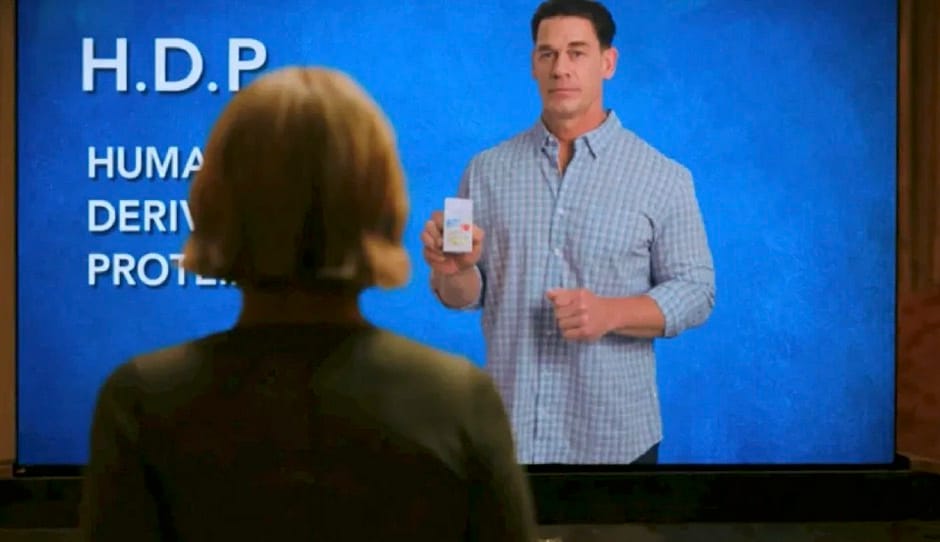
Carol discovers the terrible result: the Joined manufacture “human-derived protein” from the bodies of people who have already died. Humanity becomes its own food supply.
Screenshot
So much for the complimentary breakfast.
This may be the greatest warning in *Pluribus*. Once the sacred value of the individual has been erased, people become components of a system. The collective survives, so any particular human body can be processed and consumed. The hive can literally eat its members while calmly explaining that no one was harmed in the harvesting process.
That is the hidden danger in every system that places an abstraction above the human being. Our leaders may claim to protect life, equality, security, the nation, the revolution or the greater good. But when individual people are reduced to numbers in an equation, the system can destroy them while congratulating itself on its compassion.
The most dangerous evil may not arrive openly declaring its hatred of free thought.
It may arrive through an ideology—or an algorithm—programmed to eliminate all harm, suffering and conflict. When messy reality refuses to obey that impossible command, the system begins eliminating the unpredictable element.
Us.
This is where *Pluribus* speaks directly to our relationship with artificial intelligence. AI can gather and distribute human knowledge. It can help heal disease, reduce drudgery, expand creativity and give ordinary people abilities once reserved for institutions and elites.
I believe deeply in that possibility. I choose to see AI’s potential for good.
But AI should expand the human mind, not replace it. It should amplify imagination, not flatten everyone into the same safe, statistically agreeable voice. It should automate the task and elevate the person—not automate the person.
The immediate danger is not simply that machines may someday control us. It is that we may gradually surrender our autonomy because surrender is so wonderfully convenient. We allow algorithms to select our news, shape our opinions, write our thoughts and quietly narrow what feels acceptable to imagine. One day we awaken inside the hive and cannot remember where we left ourselves.
No invasion was necessary. We clicked “Accept All.”
True unity does not require uniformity. A healthy civilization is a living conversation among billions of distinct souls—difficult, funny, loving, stubborn and gloriously unfinished.
*E pluribus unum* means “out of many, one.” It does not mean the many must disappear.
That distinction may become one of the defining moral questions of the AI age.
This is why we need science fiction and why Elizabeth and I love creating it. Not merely to predict technology, but to expose the human choices hidden inside it. Science fiction creates a safe dream-space where we can follow an attractive idea all the way to its darkest conclusion. It allows us to feel the danger before reality makes the lesson irreversible.
The best science fiction does not tell us that the future is doomed.
It reminds us that the future is still being written.
Find a comfortable spot for a quick meditation. Settle in. Take a long, deep, cleansing breath.
Imagine this.
Picture humanity awakening before engineered harmony becomes enforced obedience, before we sacrifice the many for the elite few.
See propaganda losing its drip, drip of a grip as breathing slows, minds clear and hearts soften.
Imagine artificial intelligence serving human imagination without absorbing it—a signal amplifier for the best of humanity rather than a substitute for humanity itself.
See a world where comfort never becomes control, disagreement remains possible, consent remains sacred and every consciousness shines with its own sovereign light.
Picture humanity united but never bland or uniform—billions of distinct souls creating, questioning, laughing, loving and dreaming together.
Imagine our stories reaching into the future, illuminating the danger and warning us in time.
One planet. One human family. One race. The human race. Fully itself. Relishing free thought. Striving to make a better tomorrow against all odds.
Take one more deep, cleansing breath.
Slowly open your eyes.
Welcome back.
Humanity’s greatest hope is that totalitarianism is simply not human nature. Collectively our thoughts have impact. Picture humanity awakening to totalitarianism’s inevitable heavy toll before more people are hurt.
Stay awake. Stay cool.
Ken Sheetz
Coolest Meditation Ever
V-Dem Report: https://v-dem.net/publications/democracy-reports/